
Forest Park block record sources
A Forest Park block search has several narrow sources, not one public list of neighbors. CAGIS shows a parcel's map position and surrounding geometry. The Auditor gives labeled tax-record fields for one parcel. The Recorder connects a parcel or legal description to recorded land documents. City records may answer a known permit or maintenance question. Each source should be read for the fact it actually displays, without turning a nearby parcel or a tax mailing field into a conclusion about who lives there.
| Source | What It Shows About a Block | Access |
|---|---|---|
| CAGIS Online | Parcel geometry, map context, and adjacent-parcel selection | Public map service; not a survey or title decision |
| Auditor parcel card | Parcel ID, situs, tax-record owner, mailing field, legal description, and transfers | Free public portal; not an occupancy list |
| Recorder Acclaim | Recorded instrument parties, dates, numbers, and land descriptions | Public index with separate image or counter paths |
| Building Department or NextRequest | Known City permit, inspection, or maintenance record by address and date | Counter, phone, or narrow City request; no public address search verified |
| Ohio voter channels | Individual registration check or date-specific county snapshot | No interactive street browse; protected fields are excluded |
A tax-record owner, tax-mailing addressee, recorded grantor, and voter return are distinct roles. Forest Park neighbors can be researched responsibly only by retaining those labels and the source date for each result.
Start with one address and a narrow question. “What parcel touches this one?” is a map and parcel question. “What deed is linked to this lot?” is a Recorder question. “Is there a known City permit record?” is a department or request question. Separating those questions avoids the false promise of a Forest Park neighbors list and makes a later custodian request more precise.
Mapping Forest Park neighbor parcels
The adjacent-parcel method is parcel-first. Begin with one Forest Park address in the Auditor, save its parcel ID and legal description, then locate the same parcel in CAGIS. Turn on parcel boundaries and note visible cross streets. Identify only polygons that directly touch or face the anchor when the map makes that relationship clear. A large buffer can cross a street or catch a diagonal lot, a common area, a right-of-way, or another feature that is not a neighboring household.
- Search the anchor address in the Auditor with the number and street base, and preserve its returned parcel ID and source date.
- Resolve the parcel in CAGIS, select its boundary, and record the displayed map context.
- List directly contiguous or facing parcel IDs as map candidates, not as people or household relationships.
- Open each candidate in the Auditor one at a time and preserve its situs, tax-mailing label, legal description, and transfer tab separately.
- Use the parcel ID or legal description in Acclaim only when a recorded-instrument question remains.
The Forest Park street directory covers the broader by-street record chain. This block method remains focused on immediately adjoining parcel geometry.
CAGIS is useful for location and spatial context, but it is not a legal survey or recorded boundary. An irregular parcel, private drive, park, drainage tract, or border road can make an apparently close polygon a poor candidate for a neighbor question. Keep the selected map layer and date with the parcel notes, then use the Recorder or plat for a legal-boundary question.
Forest Park parcel role limits
The Auditor card is a tax and property record. Its situs field is the location of the taxable parcel, while its tax-mailing field is where correspondence is directed. The displayed owner is the tax-record owner for that record. Those fields can be useful research anchors, but neither a mailing address nor a recorded name proves current occupancy, a household relationship, or a connection between Forest Park neighbors.
- Parcel
- A county tax-record unit with its own parcel ID.
- Situs address
- The physical location assigned to that taxable parcel.
- Tax-mailing address
- The address listed for tax correspondence, which can differ from the situs.
- Legal description
- The lot, subdivision, or other recorded land description used to connect county records.
If an Auditor result uses a trust, estate, company, or several names, preserve that displayed form. Recorder party roles and dates are the next check when the question concerns a recorded transfer, not a shortcut to a neighbor identity.
Forest Park voter record limits
Ohio My Voter Information is a known-person check requiring first name, last name, and county. It does not offer a Forest Park street-browse or block-browse control. The DATA Act File Search supplies date-specific county snapshots under its own election, date, and county controls, but a Hamilton County snapshot is not a city-run neighbor roster. Ballot choices remain secret, and the snapshot date must stay with the result.
Ohio Revised Code 3503.13 defines public voter registration access and exclusions.
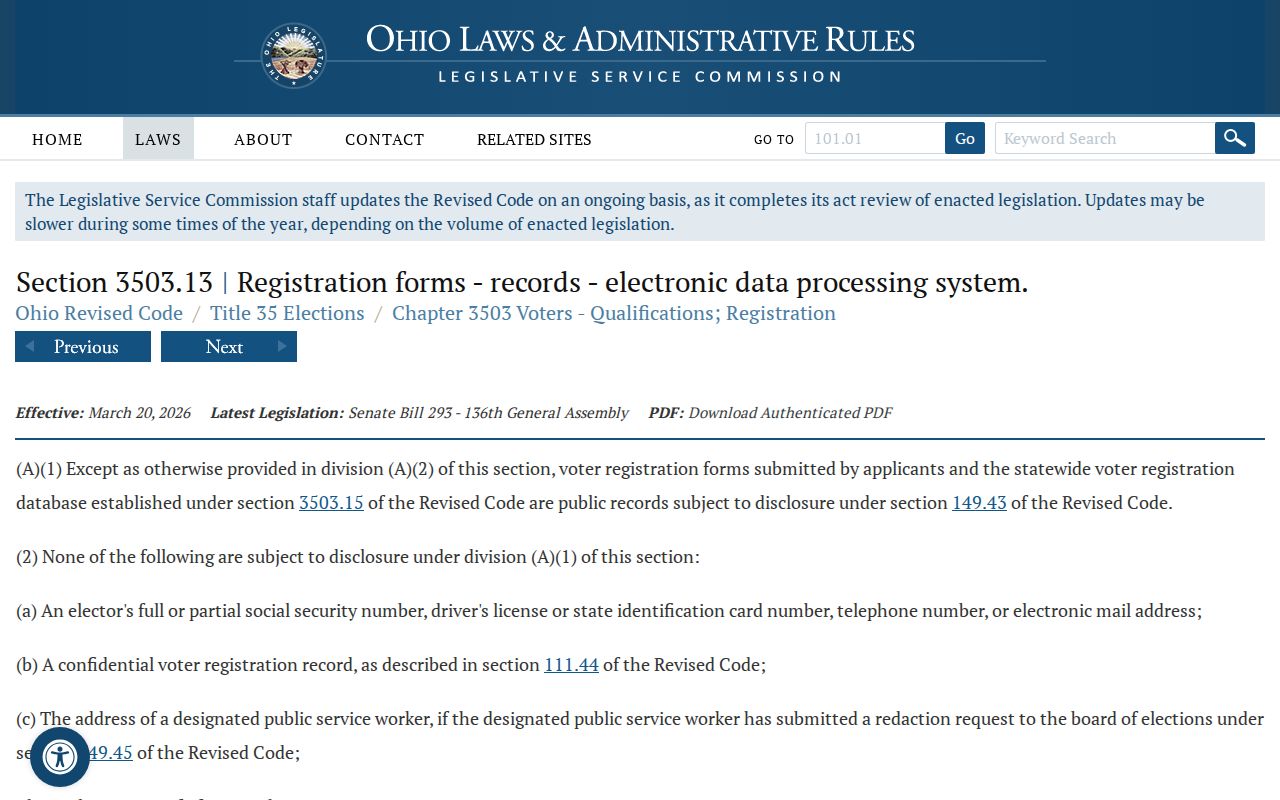
Protected identifiers, confidential voter records, and other excluded fields stay outside a Forest Park neighbors search.
A nonmatch has several possible explanations, including a name variation, a prior county, maintenance activity, an input mismatch, or confidential status. It should never be turned into a negative claim about a person or address.
Forest Park community information
No official Forest Park neighborhood-association or HOA membership directory was verified. That absence matters. A City agenda, a local branch, or a library referral can help locate public civic or historical material, but none should be presented as a roster of Forest Park neighbors. The verified public channels below lead to documents, requests, staff assistance, and historical collections rather than private household lists.
| Public community channel | Useful Forest Park information | Boundary |
|---|---|---|
| Forest Park CivicWeb | Published agendas, meetings, reports, ordinances, and City documents | Not a neighborhood or household directory |
| Forest Park NextRequest | Current intake route for a focused public-records request | Request access does not create a neighborhood roster |
| Forest Park Branch Library | Staff referral, research databases, and local service information | Not identified as a complete historical-directory shelf |
| CHPL Genealogy & Local History | Directory, newspaper, obituary, and local-history research route | Confirm a collection's year and coverage before using it |
Voluntary groups may have private membership information, but no public official Forest Park source for such a directory was located. Use information only where the organization itself publishes an appropriate public contact or record.
The Forest Park Branch is an especially practical first handoff for a local-history question because it serves Forest Park, Springdale, and surrounding communities and connects readers to countywide research databases. For an older address, ask staff whether a cataloged city directory, newspaper, or local-history source covers the requested year before treating it as block evidence.
Forest Park's 1956 block story
Forest Park's first homes opened in the C section in March 1956, yet Hamilton County land and Probate archive routes begin much earlier. That split helps explain a block map with a postwar street pattern and an older county land trail. The first useful record for a Forest Park block may be a current parcel or subdivision description, while predecessor land needs Recorder, Probate, plat, or archive research.
When a parcel history reaches a development transaction, preserve the subdivision and lot, Book/Page, legal description, and predecessor party names. Do not expect a modern street number alone to reach the land before the city developed. A 1950 census or a pre-1956 directory may describe predecessor geography, not an incorporated Forest Park household.
Forest Park custody search boundary
Public-safety systems have their own narrow purpose and are not Forest Park neighbors evidence. The Hamilton County Sheriff inmate search is for current county detention information, which changes with booking and release. It does not establish a person's current residence, block connection, court outcome, or relationship to an address. A court question belongs with its relevant docket and case record.
Hamilton County Sheriff Inmate Search is the county custody route.
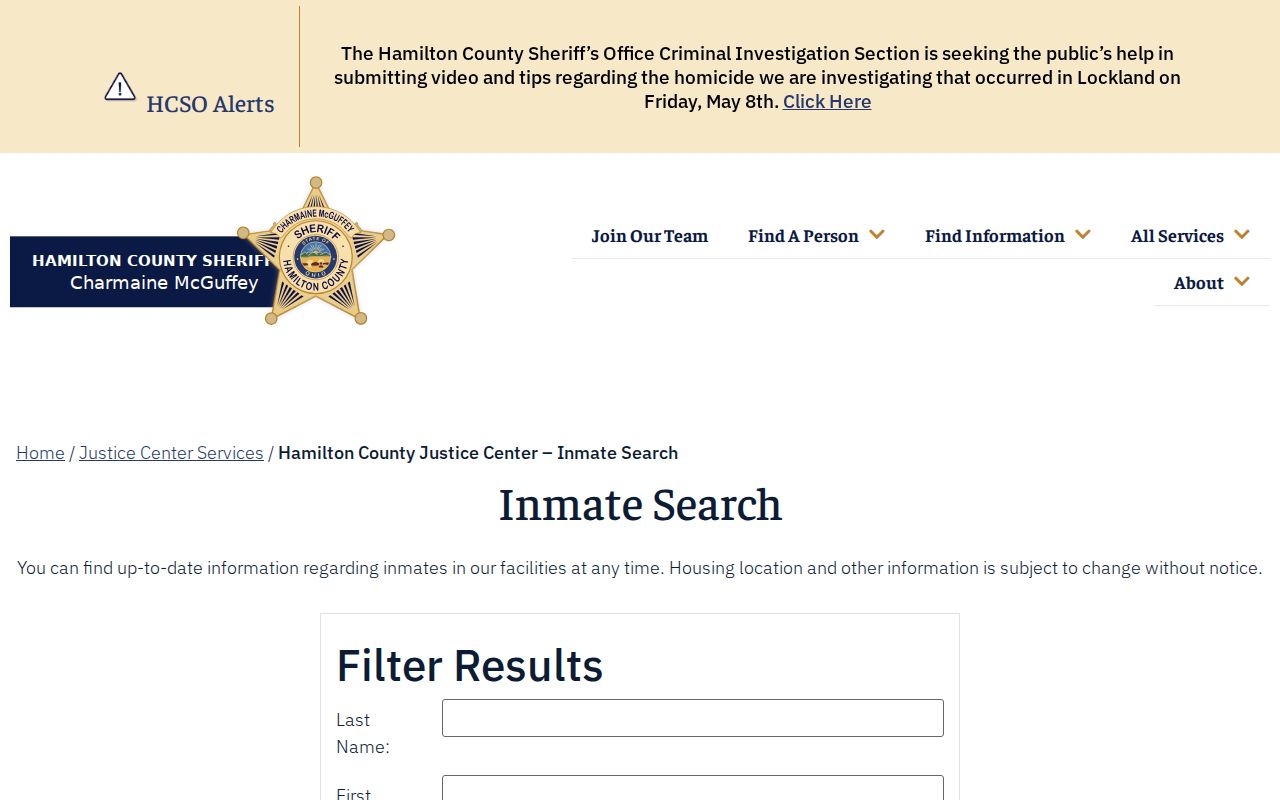
A custody listing must be read with its source and time limit, never as a neighbor lookup or complete court history.
For a Forest Park Mayor's Court matter, use its separate docket and verify the case number and disposition. County court records use the Clerk's categories and access rules. Sealed, juvenile, and otherwise confidential material remain outside public inference.
Forest Park neighbor source comparison
Official parcel and document systems preserve fields tied to a named custodian. Commercial neighbor-finding categories can combine public and claimed data, but may be stale or join similar people incorrectly. For a Forest Park block question, verify a lead against the parcel, legal description, recorded instrument, or dated public record that actually supports it.
| Official Forest Park record path | Commercial compiled category |
|---|---|
| Shows a source-specific parcel, map, document, or public record field. | May combine sources with uncertain update dates and identity matching. |
| Can be checked through its county or City custodian. | Needs verification from the actual records office or library repository. |
| Keeps owner, party, and map roles separate. | Should not be used to infer household membership or neighbor relationships. |
Forest Park neighbor privacy limits
Ohio Safe at Home can give qualified participants a substitute address and confidential voter treatment. Public records also have source-specific exclusions and redactions. A confidential field, a sealed court file, or a no-result is a stopping point, not an invitation to reconstruct protected information from other sources. Corrections belong with the office that created the record.
Ohio Safe at Home explains the state address-confidentiality program.
The program is a reason a public Forest Park neighbor query can have limited or no visible address information.